
Every few years, someone tells me Las Vegas real estate is doomed because the casinos are quiet. Every time, the residential market writes a different story.
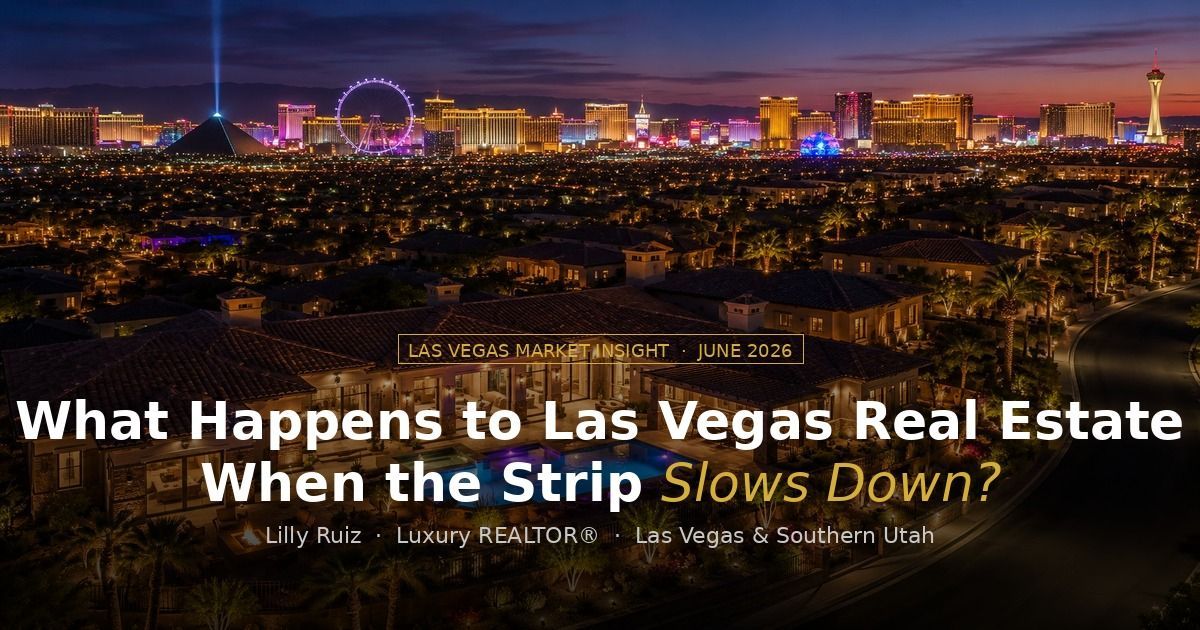
Las Vegas has one of the most visible economies in the world. The Strip generates billions, occupancy rates make national headlines, and when convention traffic dips, everyone notices. So it is a fair question — if the casinos slow down, does your home lose value?
The answer is more nuanced than most people realize, and understanding it is the difference between making a panicked decision and a smart one.
The Strip and the residential market are not the same thing
Las Vegas has spent the last decade doing something most outsiders have not caught up to: diversifying. The economy that once ran almost entirely on gaming and hospitality now includes a growing tech sector, professional sports, logistics, healthcare, and an expanding base of remote workers and retirees relocating from California.
That shift matters because residential real estate does not move on casino revenue — it moves on population, employment, and migration. And on those three metrics, Las Vegas has remained resilient even when the Strip has had a difficult year.
Las Vegas Valley 2026
price appreciation
income tax
What actually happened during past Strip slowdowns
Look at history and a clear pattern emerges. After the 2008 financial crisis, Las Vegas residential real estate was hit hard — but it also recovered faster than most major markets. During COVID, when the Strip went dark entirely, home prices in the valley surged because migration accelerated and remote workers arrived in large numbers. The two markets do not move in lockstep.
The current moment follows a similar logic. Tourism and convention traffic softened in 2025, and gaming revenue took a hit. But the residential market has largely absorbed that without a collapse. Prices remain elevated, inventory is still constrained by limited developable land, and California migration continues to bring buyers with strong purchasing power.
Las Vegas tends to cool first and rebound early. If you buy during the slowdown, you are likely to capture the momentum as the market turns.
Strip slowdown vs. residential reality: a side-by-side

| Factor | Strip / Gaming Economy | Residential Market |
|---|---|---|
| Primary driver | Tourist volume & convention traffic | Population growth & migration |
| 2025–2026 trend | Declining visitor numbers; gaming revenue pressure | Prices flat to modest growth; inventory constrained |
| Biggest stabilizer | Sports events, F1, major concerts | California inbound migration Ongoing |
| Land availability | Strip is landlocked; expansion limited | Residential land scarce; limits supply pressure |
| Recovery history | Tied to national travel & spending cycles | Among fastest to rebound post-recession nationally |
| Tax environment | Nevada gaming tax | No state income tax; attracts wealth relocation |
What buyers and sellers should actually watch
The real indicator for residential real estate in Las Vegas is not casino revenue. It is mortgage rates. When rates drop toward or below 6 percent, demand releases quickly because there is a large pool of sidelined buyers who have been waiting. If that rate drop produces no activity, that is when economists start looking for deeper structural problems.
Right now, we are in a window that historically rewards buyers who move with intention rather than waiting for perfect conditions. Inventory is available. Sellers are more open to negotiation than they were two years ago. And the underlying fundamentals — tax advantages, population growth, limited land supply — have not changed.
What smart buyers are watching right now
- Mortgage rates trending toward 6% — the release valve for pent-up demand
- California wildfire and tax pressure continuing to push relocation decisions
- Luxury communities (Summerlin, MacDonald Highlands, The Ridges) maintaining pricing strength
- New construction pace — builders are pulling back, which limits future inventory
- Southern Utah as an alternative to Vegas luxury for those seeking quieter markets
The bottom line
A slow Strip does not automatically mean a struggling residential market. The two economies share a city but respond to very different forces. Tourism dips; people still need homes. Casinos feel the squeeze; remote workers still move to Nevada for the tax savings. Convention traffic softens; retirees from California still arrive with equity from their sold homes.
What the current moment does create is an opportunity for buyers and sellers who understand the distinction. If you have been sitting on the sidelines waiting for Las Vegas real estate to collapse because you heard the casinos are struggling — that is not how this market works, and waiting may cost you more than you think.
If you want to talk through what this means for your specific situation — buying, selling, or investing — I am happy to walk through the numbers with you directly.
Disclaimer: Market data and statistics referenced in this post are sourced from publicly available real estate reports and news sources as of June 2026. Market conditions change frequently. This content is for informational purposes only and does not constitute financial, legal, or tax advice. Please consult a licensed CPA, attorney, or financial advisor regarding your specific situation. Lilly Ruiz is a licensed real estate agent in Nevada (NV Lic# BS.145724LLC, Monticello Realty) and Utah (UT Lic# 13607070-SA, InDepth Realty).