





Proof of Funds in Luxury Real Estate: What to Redact, What to Show, and Why It Opens Doors

New Paragraph
Ever wondered why you can't just book a tour of a fifty million dollar penthouse?
In ultra-luxury real estate, a phone call doesn't get you through the front door. Before you ever see the inside of a premier estate, someone on the seller's side is going to ask one question: can this buyer actually close? Proof of funds is how you answer it — and buyers who understand how it works move faster, get taken more seriously, and win properties that others never even get to tour.
After sixteen years in this business, serving Las Vegas, Henderson, Summerlin, and Southern Utah, here is exactly how it works.
What Proof of Funds Actually Means
Proof of funds is documented evidence that you have the money, that it's liquid, and that it's ready to move.
Not net worth. Not "my portfolio is worth forty million." A seller's team doesn't care what you're worth on paper — they care what you can wire. Liquid, available, and verifiable. That's the standard.

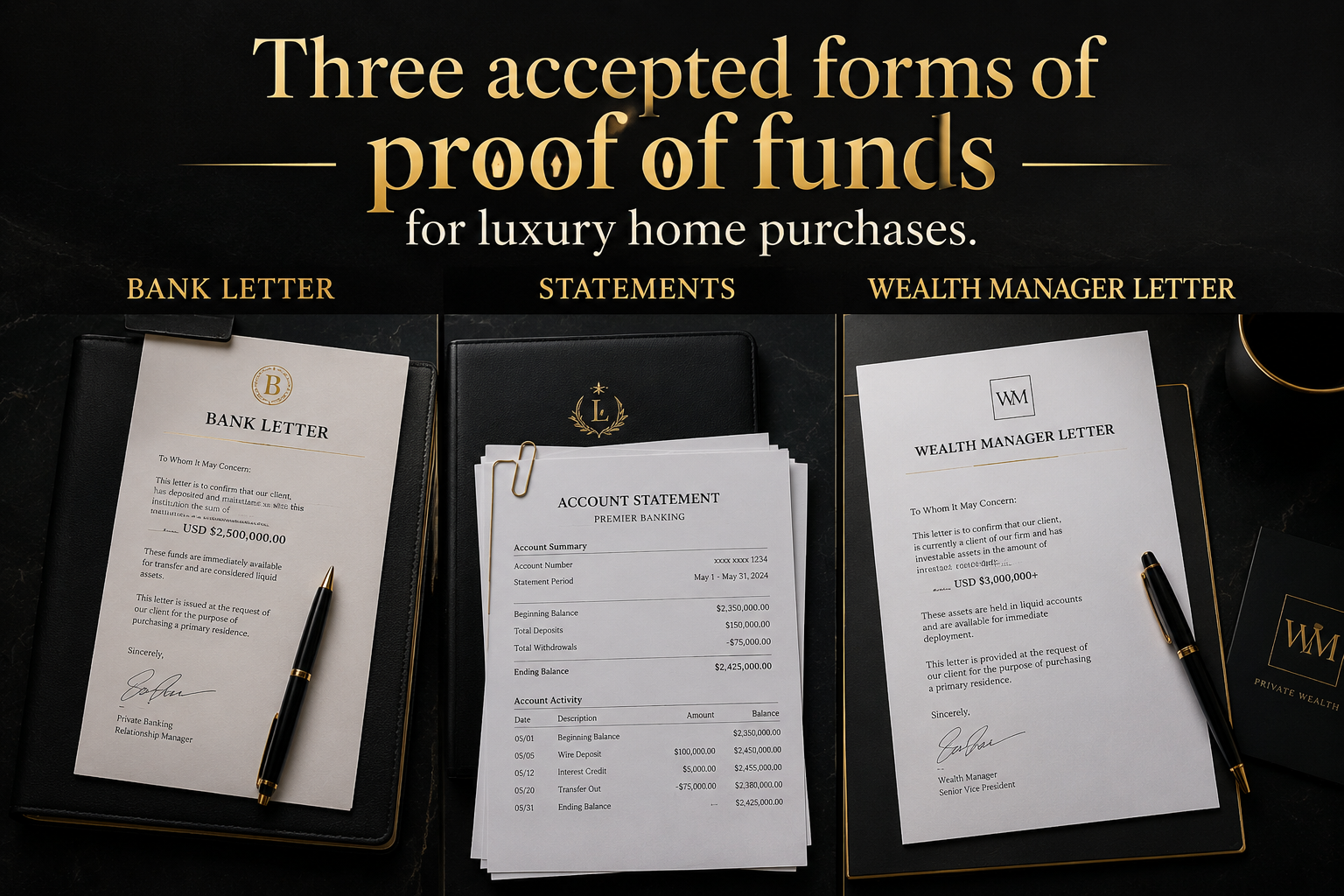
The Three Documents That Get Accepted
A bank letter. A letter from your banker, on the bank's letterhead, dated within the last thirty days, confirming the funds are available. For fast closings, the listing side may ask for a letter that specifically confirms the money can be wired within a defined number of days.
Recent bank statements. The most common option — and the one that raises the most questions, because nobody wants to hand strangers their financial life. More on exactly what to black out below.
A wealth manager letter. If your money sits in managed investments, a letter from the firm confirming your liquid position is often cleaner than raw statements.

What About Crypto?
The honest answer: crypto sitting in a wallet is generally not accepted as proof of funds on its own, because the value can swing overnight.
What works is one of two paths. Either an official statement from a major custodian, paired with a clear plan to convert before closing — or a loan backed by your crypto from an established institution, documented like any other credit facility. If your wealth lives on-chain, get your documentation strategy sorted before you fall in love with a property. Not after.

What to Redact — My Honest Advice
Here is where I differ from the standard advice, so let me be direct.
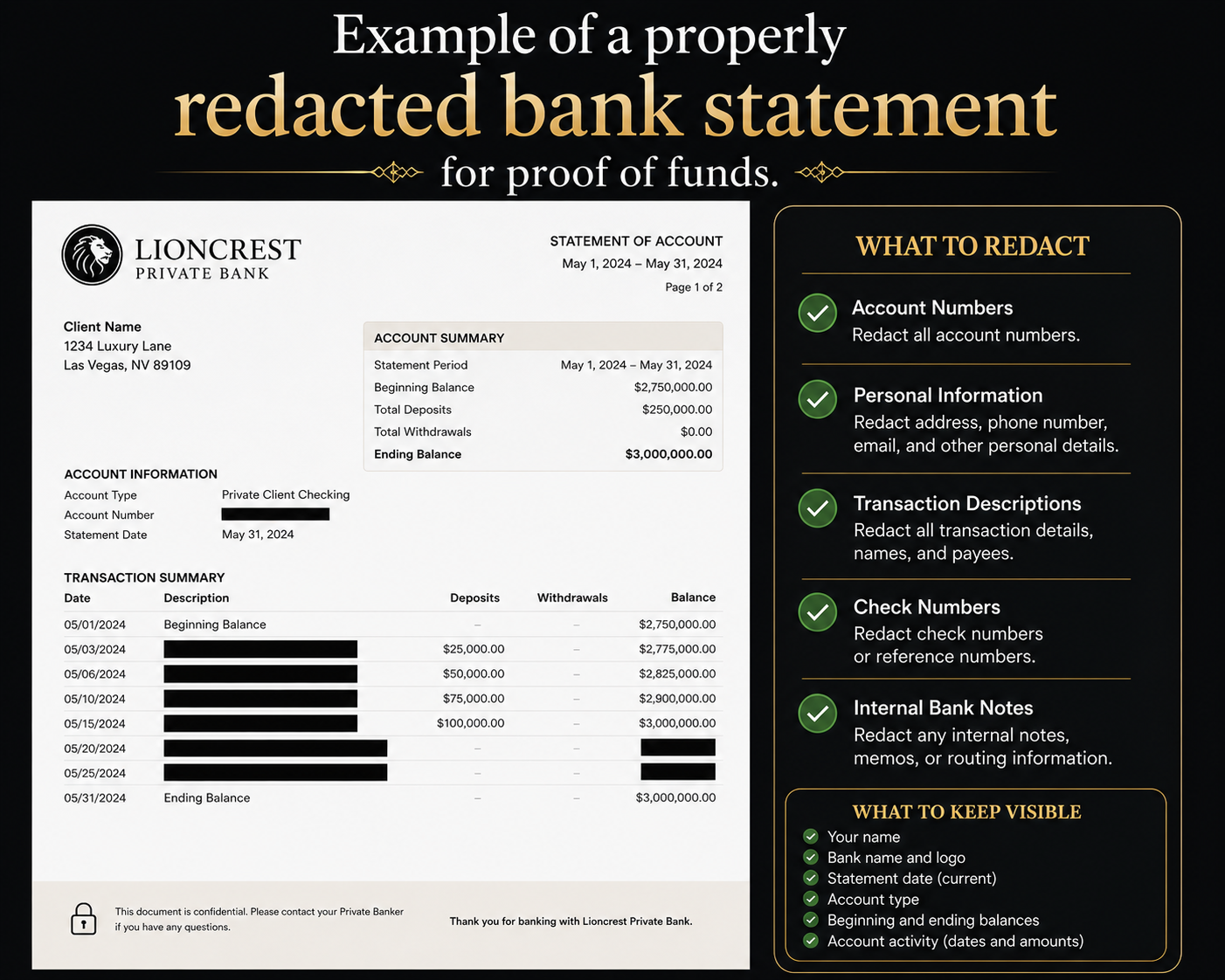
Most guides tell you to redact your account number "except the last four digits." I say redact the entire account number. All of it. The account number proves nothing about your funds — and every digit you leave visible is liability floating around in other people's inboxes. A proof of funds document gets forwarded between agents, sellers, and their teams. Treat it accordingly.
Black out: your entire account number, every individual transaction (nobody needs to see where you shop), balances of any other accounts on the same statement, and any Social Security number, tax ID, or personal identifier.
Keep visible: your name matching the offer, the bank's name and logo, the statement date (it needs to be recent), and the balance itself.
A proof of funds needs to show four things: who you are, how much you have, at which bank, as of what date. Nothing more. If deeper verification is ever needed, it happens later through escrow — where it's secure.
Why Pre-Vetted Buyers Win
This is the most practical advice in this entire article: get verified before you shop.
Buyers who show up with their financial passport already stamped skip days — sometimes weeks — of back-and-forth. On a competitive property, that speed is the difference between touring the home and hearing that it sold. In the luxury market, verified isn't a formality. It's an advantage.
And it changes how you're perceived. The moment you clear the vetting, you've told the seller's side: I'm serious, I'm capable, and I move like a professional. That reputation follows you through the entire transaction — through the showing, the negotiation, and all the way to closing.